01What it is

A cancer of the body's messenger cells

Neuroendocrine tumours develop in neuroendocrine cells: cells found throughout the body, including the gut, pancreas, and lungs, that help control hormones and everyday bodily functions. When these cells become cancerous, the tumours that form can behave very differently from person to person: some grow slowly over many years, others more aggressively.

Because neuroendocrine cells exist all over the body, NET can start almost anywhere, which is part of why it's so easy to miss.

Worth knowing

NET is more common than people think

One person is diagnosed with Neuroendocrine Cancer every 90 minutes in the UK, around 6,000 people a year. More than 36,000 people are living with it today, and it's now more prevalent than stomach or pancreatic cancer.

02Where it can start

Almost anywhere the body has these cells

NET most commonly starts in the lungs, the small bowel, the pancreas, the stomach, the appendix, or the large bowel and rectum. Wherever it starts, the underlying disease is fundamentally the same: cells that have stopped behaving normally.

Diagram showing where NET can start in the body: lungs, stomach, pancreas, small bowel, appendix, large bowel and rectum
03Why diagnosis takes so long

Symptoms that look like everything else

NET symptoms are commonly mistaken for IBS, menopause, anxiety, or asthma. On average, it takes four and a half years to get a correct diagnosis, and the average patient visits their GP 11 times before they get one.

Symptoms worth watching for:

Digestive
  • New IBS-type symptoms over 50
  • Persistent bloating or wind
  • Heartburn or stomach pain
  • Changes in bowel habit
Respiratory
  • Persistent dry cough
  • Asthma-like symptoms
  • Unexplained wheeze or breathlessness
Hormonal
  • Flushing without sweating
  • Heart palpitations
  • Menopause-like symptoms
  • High or low blood sugar
General
  • Fatigue and headaches
  • Anxiety or low mood
  • Unintentional weight loss

This is not a diagnostic checklist. No single symptom points to NET on its own, it's a pattern across more than one of these groups, especially if it doesn't resolve, that's worth raising with a GP. Early conversations are how earlier diagnosis happens.

04How it's diagnosed

There's no single test

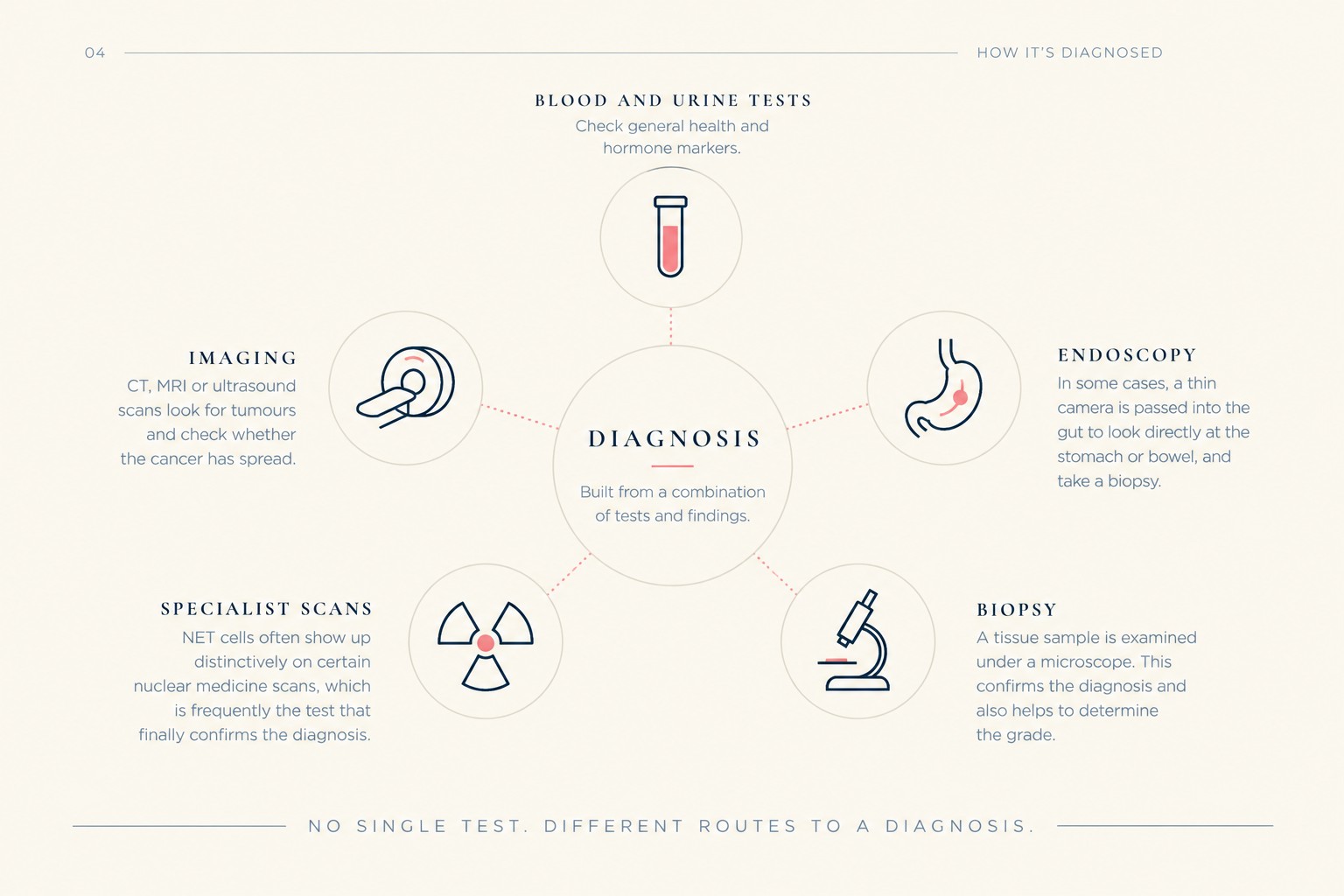
Because NET can start almost anywhere and behaves so differently case to case, getting to a diagnosis usually means working through several different kinds of test, not just one.

  • Blood and urine tests
    Check general health and hormone markers. There's no single blood test that confirms NET on its own.
  • Imaging
    CT, MRI, or ultrasound scans look for tumours and check whether the cancer has spread.
  • Endoscopy
    A thin camera passed into the gut to look directly at the stomach or bowel, and take a biopsy.
  • Specialist scans
    NET cells often show up distinctively on certain nuclear medicine scans, which is frequently the test that finally confirms the diagnosis.
  • Biopsy
    A tissue sample examined under a microscope. This is also how the grade is worked out.
Diagnosis is built from a combination of tests: blood and urine tests, imaging, endoscopy, specialist scans, and biopsy
05How it's graded

Not all NET behaves the same way

Even when it starts in the same place, NET can grow at very different speeds. Doctors grade it using a test called Ki-67, which measures how many cells are actively dividing.

Getting the grade right isn't paperwork, it decides the treatment path someone is offered. Around 70% of cases are NET, the slower-growing form, where five-year survival is above 65%. The remaining 30% are NEC, faster-growing and more aggressive, where five-year survival falls below 10%.

  • Grade 1: Under 3% of cells dividing. Slow growing, low grade.
  • Grade 2: A moderate pace. Intermediate grade.
  • Grade 3: Fast growing, high grade.
  • Neuroendocrine carcinoma (NEC): The fastest-growing form, usually treated more like other fast-growing cancers.
Earlier diagnosis doesn't just change treatment. It gives people back time.
Daily Dip 4 Dave
06Why we fundraise

Awareness

The more people, and GPs, who recognise the signs of NET, the sooner someone gets the right test.

Earlier diagnosis

Every year shaved off the average diagnosis time is a year of treatment options someone didn't have before. Treating a patient at an advanced stage costs the NHS an estimated £200,000 to £300,000 more than catching it early, so earlier diagnosis saves more than time.

Research

Funding goes toward research into NET, because better understanding of the disease is what improves outcomes long term.

Earlier conversations lead to earlier answers.

Photo: Sebastien Gabriel / Unsplash

Help fund earlier diagnosis.

Donate now